Whale Movemen2026-10-08 14:27:00How the hole-card camera changed poker — and why the same logic may be showing up in onchain tradingIn a commentary published by PANews, author @HelloLydia13 argues that poker’s rise from a closed table game to a mature spectator sport owed a great deal to one small device: the hole-card camera. By letting viewers see players’ hidden cards, the camera did not change poker’s rules or improve the players themselves. What it changed was the audience’s field of view. Actions that once looked identical on screen — a bluff, a value bet, a fold after a long pause — became legible because viewers could finally connect behavior with information. The article uses that shift as a framework for understanding recent changes in crypto trading. It says onchain markets already carry some of the same built-in visibility: entries, position size, leverage, PnL and liquidations can all exist in public view. But raw visibility alone is not enough. The piece points to livestreaming on Pumpfun in 2024, the growth of Perp DEX trading from 2025 to 2026, Aster DEX’s Human vs AI events, KBW trading streams featuring @jadoodoo_, and Coinbase’s TOKEN2049 event branding as signs that trading is becoming something people can watch, follow and interpret. Its core claim is that the next layer of crypto product design is not just about exposing data, but about turning data into something understandable. In that process, watchability, editorial control over attention, and onchain identity may become central product and market forces.620
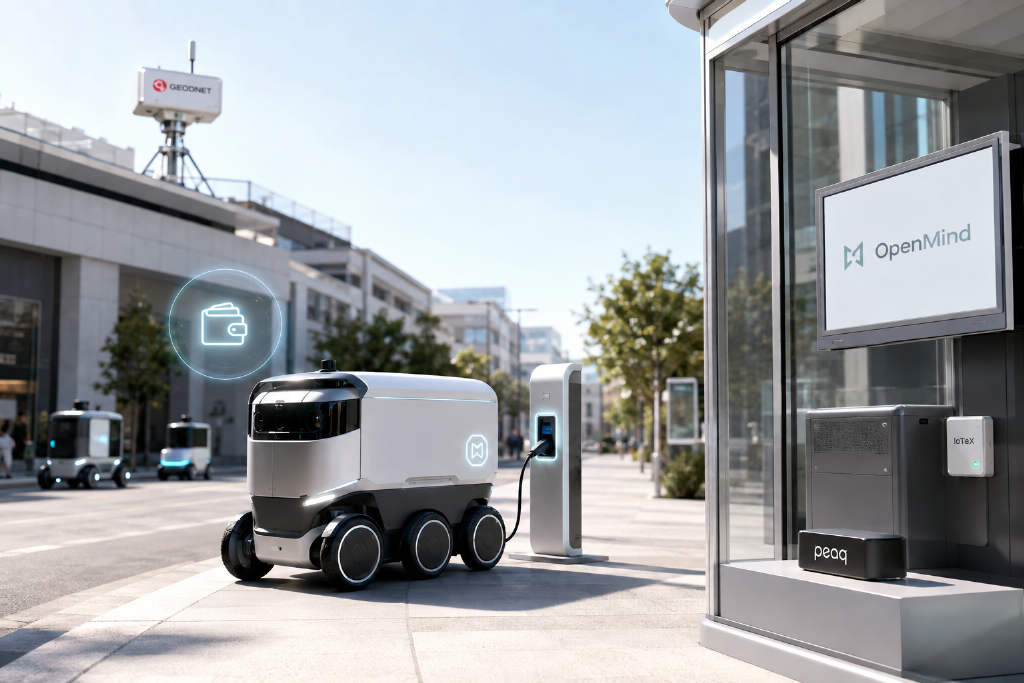
Policy and Re2026-09-04 23:56:00Crypto Projects Target a Narrow Gap in Robotics: Identity, Wallets and MicropaymentsA growing group of crypto companies is trying to solve a practical problem in robotics rather than selling a vague future vision: how machines can pay for small real-world services and prove who they are when dealing with unfamiliar counterparties. The thesis starts with a simple mismatch. Traditional payment rails were built for relatively infrequent, higher-value transfers, while robots may need to pay a few cents at a time for charging, connectivity, location data or compute. In that setting, fixed card fees and wire costs quickly become uneconomic. The article traces how several projects are approaching different parts of that stack. GEODNET uses token incentives to build RTK positioning infrastructure. OpenMind is developing a common operating layer and testing gas-free USDC micropayments. IoTeX focuses on hardware identity and proof of real-world actions. peaq is building a broader machine registry, credit framework and settlement layer, while also experimenting with tokenized machine revenue through Initial Machine Offerings. At the same time, the report draws a clear boundary around the market. Most robots do not need autonomous payment or onchain identity because they already operate inside closed systems run by large companies such as Amazon, Tesla or other platform operators. That leaves crypto serving a smaller segment: open, cross-operator and non-closed-loop machine networks.1960
AI Finance2026-09-02 06:29:59Opinion piece argues crypto will be absorbed into AI finance rather than disappearA long-form opinion article published by ChainCatcher argues that crypto is on a path to being folded into AI finance, not pushed aside. The piece, written by Alan Walker from Silicon Valley and Jiayan Kea, frames AI and crypto as two systems built on the same mathematical asymmetry: one makes it cheap to generate claims that are hard to verify, while the other makes it cheap to generate claims that are easy to verify. On that basis, the article says an economy increasingly run by software agents will need a financial layer centered on low-cost verification, zero-trust-distance settlement, and fully computable rules. The article walks through eight sections covering proof-of-work, stablecoins, agent payments, onchain identity, and machine-native credit. It cites figures including Bitcoin mining difficulty at 127.48 trillion after an Aug. 8, 2026 adjustment, stablecoin supply at $320 billion as of May 2026, and x402 processing about 165 million agent transactions and $50 million in volume by April 2026. It also references ERC-8004, Mastercard’s proposed BVNK acquisition, Visa and OpenAI collaboration, and Hong Kong’s stablecoin licensing framework. Its central claim is that crypto’s long search for product-market fit may end with software agents rather than human users. In that scenario, the label “crypto” would fade as stablecoins, proof-of-work assets, public blockchains, wallets, and DeFi are recast as components of a broader AI finance stack.1420
Base2026-07-28 15:47:12Base Build launches Verify Onchain to curb Sybil attacks in airdropsBase Build has introduced Base Verify Onchain, a new identity-verification tool aimed at tackling Sybil attacks across blockchain applications. The feature is now live on the Base Sepolia testnet and lets developers enforce rules such as one claim per real user directly in smart contracts. According to Base Build, conventional airdrop systems are often exploited by large batches of wallets controlled by professional airdrop farmers, leaving users who actually helped build products with limited rewards. Verify Onchain addresses that issue by creating a stable identity hash for each real user, allowing projects to detect multiple wallets tied to the same person without collecting private data such as names or account details. Users can verify themselves with existing accounts including Coinbase, Instagram, X and TikTok. The system then returns a verified identity credential to the smart contract, which can automatically apply claim caps, voting limits or allocation controls. Base Build said Base Verify has already been used more than 300,000 times and is serving projects including Base App, Cody, Scratch and Bracket.2110
Billions Netw2026-07-23 02:30:14Billions Network Token Teaser Draws Attention as Base and City Protocol Link Remains UnconfirmedA short teaser tied Billions Network Token to Base and City Protocol, but no launch date, listing plan, or product page has been released. Public materials only confirm the project already has identity infrastructure on Base.450
ERC-80042026-07-08 22:18:14ERC-8004 Gives Onchain AI Agents Identity, Reputation, and Cross-Chain ReachEthereum draft standard ERC-8004 is creating onchain identity, reputation, and validation rails for autonomous AI agents. More than 21,562 agents are already registered across EVM networks, led by Ethereum and Base.1980
Ethereum2026-07-08 22:18:14Ethereum’s ERC-8004 Gains Momentum as Over 21,000 Onchain AI Agents Go LiveERC-8004 is introducing onchain identity, reputation, and validation for AI agents across EVM networks, with more than 21,000 agents already registered and Ethereum leading adoption.1870
ERC-80042026-07-08 22:16:15ERC-8004 Pushes Onchain AI Identity Forward as More Than 21,000 Agents Go LiveEthereum draft standard ERC-8004 is introducing onchain identity, reputation, and validation for autonomous AI agents, with more than 21,000 agents already registered across EVM chains.1840